Your neighbor includes ...
your Repugnant Cultural Other
How to Think, by Alan Jacobs, explains the concept of the Repugnant Cultural Other (RCO), referencing Susan Harding’s article on the challenge of Representing Fundamentalism. We tend to identify with certain social groups allowing our group’s distinctions to distinguish us from other social groups, thus establishing enmity.
A visiting priest’s sermon on the Parable of the Good Samaritan brought the concept of Repugnant Cultural Others to mind.
In trying to contextualize the Samaritan’s place in society, the priest revealed her prejudicial understanding of history by casting aspersions on Southerners, apparently her Repugnant Cultural Other, as icons of racism (disregarding Northern racists and perpetuating a false narrative).
Per the priest, Samaritans were painted by the Israelites in a less-than-favorable light,
Think of the way that many white people would have perceived black people in the Southern United States many generations ago.
Is she not aware of the generational racism in the North? Does she have no regard for the slaves held by the Union until long after the Civil War’s end?
Susan Harding explained how the Scopes Trial established Fundamentalists as America’s RCO. The battle between Creationists and Evolutionists created a schism within Christianity between modernist and traditionalist values.
The “Us vs. Them,” all-or-nothing, only-one-winner mindset continues today. Progressives reject traditional values. People with whom I’ve broken bread and shared my home have given me the “unfriend” middle finger; their politics and social views have informed their faith. They see me as an outsider now, repugnant because of Bible-based beliefs.
I agree with Susan Harding’s conclusion:
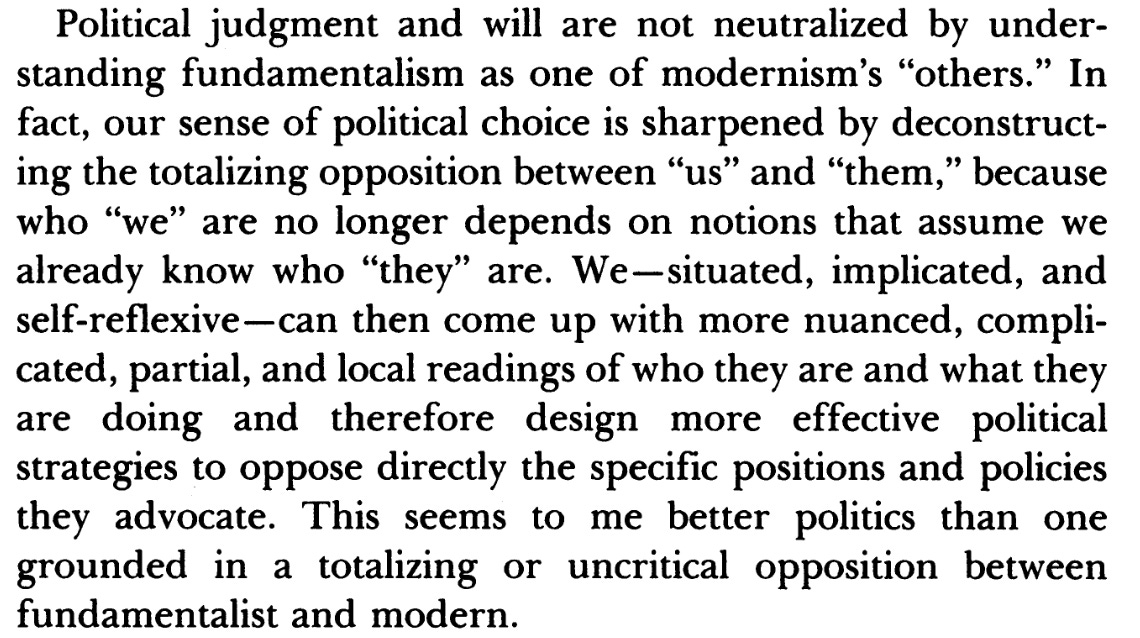
In the Parable of the Good Samaritan, the Samaritan represents the Repugnant Cultural Other. To the visiting priest, I represent the Repugnant Cultural Other.
I’m comfortable with the tension that’s created by our differences, but I find my views unwelcome by those who imagine themselves most inclusive and tolerant of diversity. How can I best bring the nuances and complexities into the conversation? A sermon offers no opportunity for discourse, but discourse is inarguably the opportunity for exchanging ideas.
I seek such discourse.
Let’s do this!